Wrap up of Professional Learning and Practice
The study of Professional Learning and Practice and adopting the learnings to a Practice-based project has highlighted my lack of knowledge around different frameworks and approaches. I have recognised that I have adopted a more traditional psychological approach to learning, when working as a Senior Manager in the VET sector. The nature of VET, even the reference to subjects as ‘units’ minimises the subject matter to a thing and all the frameworks within the VET sector focus on the acquisition of knowledge and skills as a product. Whist there is always context the focus is reduced based on the rigorous compliance requirements. Interestingly when I worked as a VET practitioner/teacher, earlier in my career, my approach was definitely sociocultural encouraging experiential learning and immersing my students in industry projects that represented workplace culture and context. I have recently worked in a startup environment where a Sociomaterial approach was touted but not practised. Engagement, agility and actor-network theory could have been part of the work culture however the senior management team were still focused on a far more transactional approach to learning and did not encourage review of practice as part of an inter-connected system. I led a reflection session at the end of last year – that encouraged discussion around the challenges, opportunities and interactions we had experienced over the past 12 months. This session resulted in acknowledgement of the social, material and cultural (Reich et al, 2015, p 376) aspects of practice and the subsequent learning.
I have found this subject both challenging and illuminating. I was struck by the textures (Gherardi, 2006) that are part of the education sector – the knowing within a class, tutorial, online; the understanding within an organisation (school, uni, institute, employer, not-for-profit); the knowing across the greater community –` the teacher, parent, student, specialists and the knowing of the community of practitioners (teachers). This spiral of knowing is inhabited in a 24 minute online tutorial and further to this the analysis using Hopwood TSBT framework highlighted so much more.
My first review of the tutorial was very much adopting the psychological approach – brain in a jar – what information is being transferred and acquired in this practice? Why isn’t it more transactional (clear tools/fact sheets)? I then reviewed the practice using detailed labels for Times, Spaces, Bodies and Things but had missed the intent of the analysis to focus independently on each but with the knowledge of the others, so there is a more nuanced analysis of the different textures and required modifications, changes and even removal of them in a professional practice context. It was only after receiving feedback for my Assessment 2 and the subsequent work I did on assessment 3 was I able to identify the patterns more clearly.
I have really enjoyed reading some of Gherardi’s (2019) studies about the texture of practice and can see correlations with Hopwood’s TSBT and Nicolini’s theory. I particularly liked Nicolini’s analogy; A rhizome is a form of ‘bulb’ that extends its roots in different directions. Every root extension forms a new small plant that, when matured, extends new roots and continues the spread. In a similar fashion, I propose that studying practices starts with one analysis and continues, grows with the contribution of other actors. This is exactly how the learning for me has evolved: me challenging my basic psychological approach to then embrace, with my teacher’s hat on, a sociocultural approach – encouraging more participation in relevant contexts and finally realising, after critiquing the Talkin’ Chalk online tutorial using the TSBT framework that the approach, perhaps, explores the more advanced Sociomaterial method with learning as ongoing, webs of practice, Learning as part of an inter-connected system rather than simply an activity (Nicolini, 2013).
Subject Learning Goals
- I have instigated innovation from the moment I commenced working. I have always seen opportunities to improve service, create new products, do things differently, for better engagement with internal and external stakeholders and have always looked at triple bottom line outcomes, as part of these ideas. I was the Chair of the Ideas Committee at the Melbourne Convention and Exhibition Centre early in my career and this experience taught me the importance of due diligence, engagement, insights over ideas, partnerships, collaboration and motivations. The committee delivered a number of initiatives around products and services plus explored the importance of team engagement, having a voice, learning how to develop and idea into an innovation and celebrating the achievements.
- Interestingly some not all ideas throughout my career have been implemented and getting a better understanding of innovation in business modelling is an area of development, for me.
- I have two job interviews this week so fingers crossed I am successful in getting one of the jobs as I would like to apply some of the learning to leading innovative learning practices with a new team. I have experienced change in many organisations and sadly very few organisations create a culture of aspiration and discovery. My experience generally is lots of bells and whistles at the launch of a new innovation and then poor execution of ideas with minimal collaboration. I’m curious to know why this happens and maybe it starts with limited evaluation and engagement with key stakeholders from the get go or poor knowledge of BAU so the innovation is too far removed from what people are doing day to day that it’s difficult for them to embrace the change (maybe it’s too abstract??).
- So I am really looking forward to this subject to lead an innovative project with clear subject learning objects adopting modern approaches to leading the required change.
My goals are:
- Achieving a better understanding of innovation in business modelling.
- Getting a really good understanding of Shatzki’s Societist approach; the importance of learning communities/societies to advocate change; practice architectures (Kemmis) – so more reading!
- Differentiating Product/Service Innovation; Process Innovation and Business Model Innovation and applying this knowledge to a project.
MODULE Wk 1, Topic 1
QUOTE: However, in
current Anglophone nations, leadership practice (and the scholarship which underpins
it) is dominated by managerialist notions of leading as a technicist activity, whose primary imperative is to render educational sites and the systems which support them,
more efficient and accountable (Gunter, 2012). Need to employ a practice-informed approach to understand how existing practise of leading can change.
PEST analysis
https://www.mindtools.com/pages/article/newTMC_09.htm
Harvard professor Francis Aguilar is thought to be the creator of PEST Analysis. He included a scanning tool called ETPS in his 1967 book, “Scanning the Business Environment,” which was later amended to PEST. [1]
PEST Analysis is useful for four main reasons:
- It enables you to spot business or personal opportunities, and gives you advanced warning of any significant threats.
- It reveals the direction of change within your business environment, so you can adapt what you’re doing to work with the change, rather than against it.
- You can use to analyze risks in your environment as well, so you can avoid starting projects that are likely to fail.
- It gives you an objective view of new and different markets, so you can base business decisions on facts rather than unconscious assumptions when you enter a new country, region, or market.
- Assessing the viability of a new venture
- Analyzing the macro environment
- WHY AND HOW: Political factors account for tariffs and regulations affecting your venture, such as the cost of selling a product or service abroad
- Economic factors help determine how much people will pay for your product or service
- Sociocultural factors give insight into the demand for your product or service. For example, a popular accessory in one country might flop in another (due to differing sociocultural values)
- Technological factors tell you whether a target market is ready for your product or service
- Legal factors help you understand the rules and regulations you’ll have to meet to sell your product or service
- Environmental factors encourage you to look at your product or service in the context of the delicate environment
- https://pestleanalysis.com/how-to-write-a-swot-analysis/
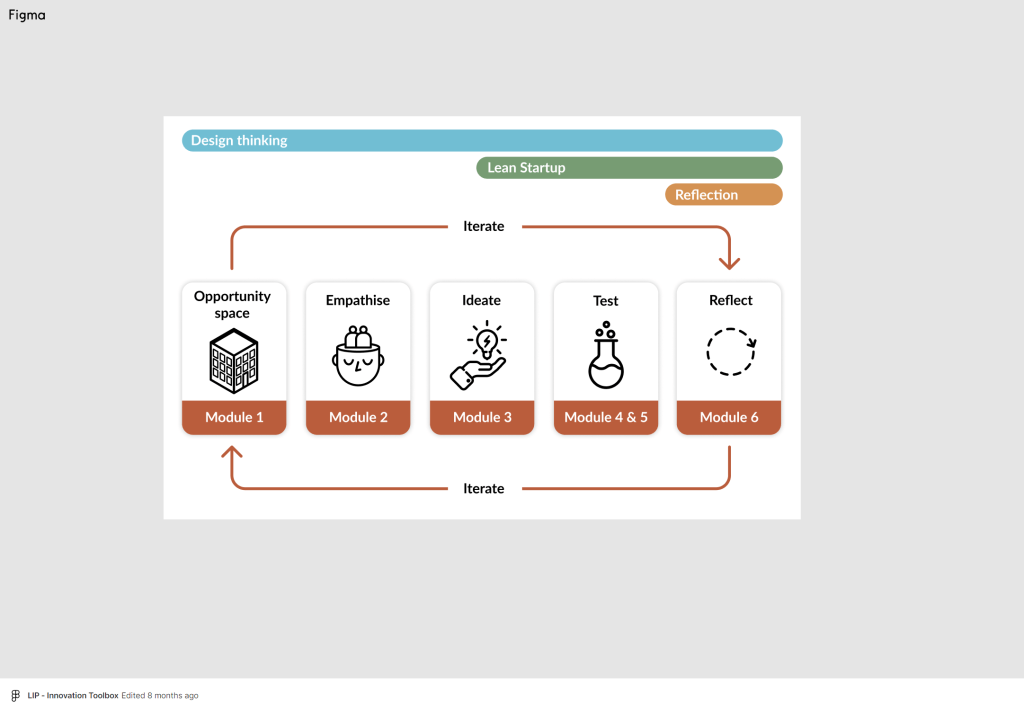
Quote: Edison’s approach was an early example of what is now
called “design thinking” – a methodology that imbues the
full spectrum of innovation activities with a human-centered
design ethos. Design thinking – Brown, T. 2008
MODULE 2 – empathy research
Empathy is at the heart of human-centred design and design thinking.
by Rikke Friis Dam and Teo Yu Siang | It requires a strong sense of imagination for us to be able to see through another person’s eyes. It requires humility so we can seek to abandon our preconceived ideas and biases. It requires that we have a heightened awareness of other peoples’ needs, wants, motivations and goals.
STEPS
- No more than three research team members should attend any single interview so as to not overwhelm the participant or crowd the location. Each team member should have a clear role (i.e. interviewer, note-taker, photographer).
- Come prepared with a set of questions you’d like to ask. Start by asking broad questions about the person’s life, values, and habits, before asking more specific questions that relate directly to your challenge.
- Make sure to write down exactly what the person says, not what you think they might mean. This process is all about hearing exactly what people are saying. If you’re relying on a translator, make sure he or she understands that you want direct quotes, not the gist of what the interviewee says.
- What the person says is only one data point. Be sure to observe your interviewee’s body language and the context in which you’re talking.
DO
- Practice active listening.
- Be comfortable with silence – let the other person fill it up.
- Use open questions: what? where? when? who? how? and importantly, why?
- Ask about specific instances, not what do you do generally/typically? E.g. Tell me about the last time you experienced this/your best experience/a frustrating experience…
- Make sure to explore thoughts and feelings – and reasons why.
- Explore ways they may have tried to solve the problem and any workarounds.
- Also find out what else is going on around them to better understand their context.
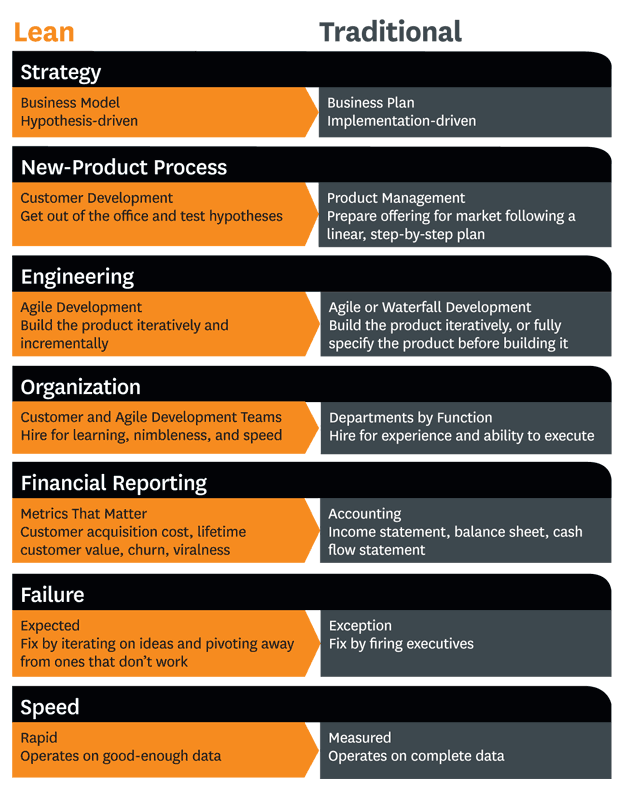
It’s a methodology called the “lean start-up,” and it favors experimentation over elaborate planning, customer feedback over intuition, and iterative design over traditional “big design up front” development. Although the methodology is just a few years old, its concepts—such as “minimum viable product” and “pivoting”—have quickly taken root in the start-up world, and business schools have already begun adapting their curricula to teach them.
Quote: Paul Graham – Do Things That Don’t ScaleWe encourage every startup to measure their progress by weekly growth rate. If you have 100 users, you need to get 10 more next week to grow 10% a week. And while 110 may not seem much better than 100, if you keep growing at 10% a week you’ll be surprised how big the numbers get. After a year you’ll have 14,000 users, and after 2 years you’ll have 2 million.
Quote:
I have not failed 700 times. I have not failed once. I have succeeded in proving that those 700 ways will not work. When I have eliminated the ways that will not work, I will find the way that will work.
Thomas Edison
Quote: A product is a compromise between a creative intention, a technical reality imposed by manufacturing and a commercial opportunity. Marion Gillet from article: Perfection: the inventors greatest enemy.
Wrap up of Professional Learning and Practice
Achieving a better understanding of innovation in business modelling.
Getting a really good understanding of Shatzki’s Societist approach; the importance of learning communities/societies to advocate change; practice architectures (Kemmis) – so more reading!
Differentiating Product/Service Innovation; Process Innovation and Business Model Innovation and applying this knowledge to a project.
 UTS Portfolio - Professional & Organisational Learning