Wrap up – learning and its trajectories
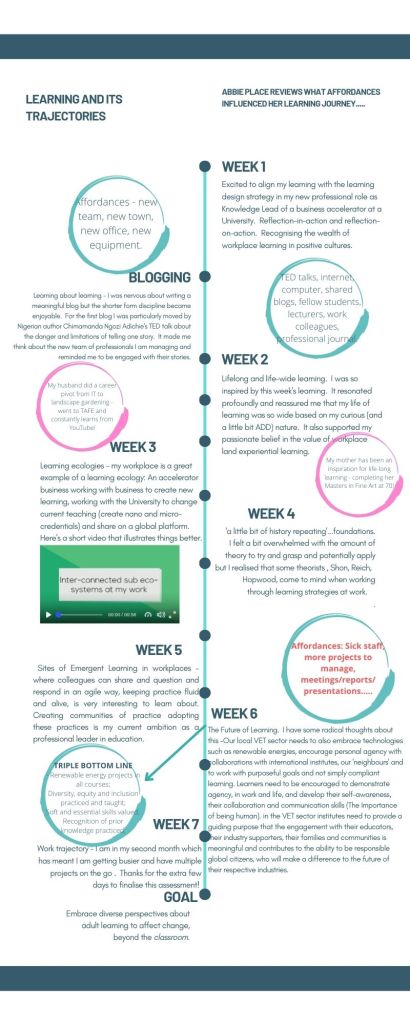
As a VET practitioner for most of my career I have always had an eye on what is future-forward in learning design, what will differentiate the learners’ skillet to others, what do industry need from our learners and how can the VET sector work more productively with Higher Education. These are BIG questions, right? I recall writing a paper (after the Visa issues of the mid 2000’s focusing on hair-dressing and cookery Visas to migrants from SE Asia) that in contrast focused on specialised courses that embraced triple-bottom-line considerations, contributing to climate change issues, social reforms and economic prosperity. I was an SME in event management, so the focus was on managing our carbon footprint at events with offset programs, adopting bio-tech initiatives at music festivals and major events, embracing technology to reduce travel and tree-planting initiatives. I was (and am) passionate about social-enterprises – so working with catering companies that celebrated Indigenous foods or companies that were aligned with charitable initiatives that supported the disenfranchised and disadvantaged. Finally, the initiatives I advocated for were about creating financial sustainability – so programs that were not reliant on Government grants every year (use seed funding to create sustainable models) and support the framework of social firms to build capacity.
The two things I hadn’t considered in my overall design were the use of technology and the importance of inclusion and equity (how do we recognise the unique characteristics for our students?)
It was shamefully apparent with the advancements in technology there were significant inequities experienced by our neighbouring countries throughout the pandemic. Perhaps our Government needs to work more collaboratively with our neighbours to support developments in IT infrastructure in education. Collaborations with companies like IBM, Adobe, Lenovo, with the World Bank backing, need to consider the global learner like the Nigerian working in the gig-economy to access pathways for further learning (Sama).
Our local VET sector needs to also embrace technologies such as renewable energies, encourage personal agency with collaborations with international institutes, our ‘neighbours’ and to work with purposeful goals and not simply compliant learning. Learners need to be encouraged to demonstrate agency, in work and life, and develop their self-awareness, their collaboration and communication skills (The Importance of being human). The institutes need to provide a guiding purpose that the engagement with their educators, their industry supporters, their families and communities is meaningful and contributes to the ability to be responsible global citizens, who will make a difference to the future of their respective industries.
Subject Learning Goals – Designing Innovative Learning
I have instigated innovation from the moment I commenced working. I have always seen opportunities to improve service, create new products, do things differently, for better engagement with internal and external stakeholders and have always looked at triple bottom line outcomes, as part of these ideas. I was the Chair of the Ideas Committee at the Melbourne Convention and Exhibition Centre early in my career and this experience taught me the importance of due diligence, engagement, insights over ideas, partnerships, collaboration and motivations. The committee delivered a number of initiatives around products and services plus explored the importance of team engagement, having a voice, learning how to develop and idea into an innovation and celebrating the achievements.
I have also introduced innovations in learning – as a VET practitioner and a Subject Matter Expert in Events. I created opportunities for experiential learning and industry partnerships, that gave students real-life event learning. The innovations were small but significant. I created interdisciplinary events – with art and design students designing marketing material, industrial design students exhibiting their work – jewellery and furniture and the hospitality and event students creating a special exhibition event. The cross-disciplinary exercises was excellent for staff morale and positive for student learning and recognition.’
I’m currently in a new role – Knowledge Lead, New Business Accelerator – and every day is about innovation – in contrast with the design of more traditional academic programs. I’m so excited and grateful for this opportunity but appreciate it will be a marathon (with tiny innovative sprints) not a quick sprint to the finish line!
My goals are:
A) I hope to use micro-innovations I’ve adopted in the past, as a VET teacher and manager as examples to support the analysis of learning design context and processes. Adopting different models of program planning and design to implement change to short course design and delivery.
B) I hope to use the inclusion of DEI as part of all course designs as my learning scenario. As part of this I am working with the Indigenous Innovation School to include appropriate referencing. Where possible we would like to work with Aboriginal and Torres Strait Islander faculty and students to demonstrate their innovation and practices and embed in some of the learning design – graphic design; case study inclusions; testimonials (audio files in Indigenous languages, with interpretation).
C) Design an innovative learning initiative appropriate to a learning scenario. This will probably be a workshop with my team to discuss and engage with the importance of diversity, equity and inclusion – and what this means for us as educators and education designers. We will also explore how DEI can be integrated subtly into program development and learning design.
D) Communicate appropriately using a range of genres and technologies. I hope to continue learning about different technologies – I like making short animations to demonstrate an idea so I will probably explore this. I would also like to experiment with the team, using virtual reality to explore DEI more intimately.
- Achieving a better understanding of innovation in learning. My goal here is to contribute to all forums – I sometimes get busy and/or self-conscious that my responses and/or answers are not going to be clever enough, but I want to get over this and respond with meaningful micro-blogs.
- Differentiating Product/Service Innovation; Process Innovation and Business Model Innovation and applying this knowledge to a project. I think I will be looking at the three models – for my assessment – developing a learning product about DEI (maybe using VR; looking at embedding these values and principles in the online learning design templates and looking at some change management around the business model to ensure values are consistent across short course design, even B:B initiatives, so educating our clients regarding Institute and societal values around DEI.
MODULE 1
MODULE 2
Learning at and through work
Workplace of the future.
You might like to think about the following in regards to your learning scenario for this subject:
- Who are we designing for?
- What will they need to know?
- How might people be incorporating or experiencing learning in a day like this?
MODULE 3
MODULE 4
 UTS Portfolio - Professional & Organisational Learning