SUBJECT LEARNING OBJECTIVES:
A) I’ve just commenced a new role – Knowledge Lead, New Business Accelerator with Federation University so the opportunity to analyse the learning design from the client, student, department, university academics and other universities perspectives (as context) will be fascinating. I’m keen to develop improved processes using the different models of program planning and design to meet the needs of the varied stakeholders and achieve some program outcomes by September.
B) The learning scenario I will explore will be either a Short Course for the dairy industry – a combination of asynchronous online learning and synchronous online forums OR a hybrid leadership workshop involving a series of face-to-face workshops and online learning (flipped classroom) with a local Government group.
C) I’m curious to instigate a learning initiative that allows students to facilitate a number of online forums – demonstrating their understanding of the learning (in their context) to engage with their peers and learn about the unique perspectives each will demonstrate. I’m also interested in augmented reality and how further learning, beyond the course, can encourage students to create their own innovative practices and/or communities of practice.
D) I made a film (not a very good one!) using Powtoon in Learning in the Digital Ag and would like to explore using more innovative technology in this subject.
Piquing interest in further study – whether a micro-credential or short course or a qualification – is definitely part of my remit, in my current role. The notion of lifelong learning for industry and graduate students. Having worked in many organisations where Change Management has not been done effectively I’m keen to imbue deeper empathetic understandings of the learner and the wider cultural influences to ensure learning is not only relevant to the subject-matter but to the societal changes we are experiencing.
A linking statement:
What I learnt in Learning in the Digital Age:
The subject is relevant for all of us but I was particularly interested in the uptake in digital offerings like augmented and virtual reality in education settings. I think it’s important to evaluate digital options carefully however I love the startup mindset to share, trial, change and encourage agile practices in all education environments (this also linked to Leading Innovation Practices, how could new ways of doing things with tech be introduced to teams?) . Some environments I have worked in move at a glacial pace and this can impact engagement and morale. I got a bit bogged down in change management because I believe creating an inclusive engagement, particularly with tech, is super important to the success of a digital strategy (I think this was also based on my understanding of creating a more holistic review of communities of practice and applying professional learning frameworks, that highlighted unique perspectives and textures when studying Professional Learning and Practice.)
When completing Learning in the Digital Age I was interested in the commentary about Social platforms and whilst there is definitely relevance I don’t think they are essential to positive learning, unless moderated. For instance I was a mentor for the Humanitarian Hackathon with the University of Sydney last year and Slack was brilliant for the 3 days of this event, but it was the nominated platform for everyone was engaging equally and essentially, so it worked. FB can be good for events and LinkedIn for employment opportunities.
I liked reading about Cal Newport’s theories on Deep Work and how important it is to apply oneself to deeper thinking/learning (I know I need to!). I worked in a startup environment for 12 months and there was an element of kids in a candy store – what platform can we use next?! I think a considered approach should always apply and code of conduct and terms of use should also be considered. For example if an organisation decides they’re going to use Slack or WhatsApp as part of their internal comms strategy but don’t advise that it will apply to informal commentary or ideas/solutions/tips and tricks or celebrations/wins and the teams start sharing project work on it – even though Asana or another platform was nominated, it can get very choppy and difficult to consolidate all discussions around a topic.
I love tech and I’m excited about the possibilities (Duoling.com – Italian anyone?) but I do think deep thought still applies and this quote sums it up nicely:
“As technologies evolve… educators and institutions must continue to reflect on the extent to which established pedagogies and teaching approaches need to evolve. Further, whilst technologies such as AI and Machine Learning can make new learning tools and services possible, we might also want to take a step back and question what we are aiming to achieve. After all, just because something is technically feasible, it does not necessarily mean it should be done or that its effects will be overwhelmingly positive.”
I believe the learning I will experience in Learning and its Trajectories will provide a deeper understanding of perspectives – I’m already fascinated by the notion of the single-story and analysing assumptions. The fact that a single-story can be true but more often than not, incomplete is an interesting and maybe slightly daunting concept (how many lenses does one use to understand a story comprehensively?). To add the broader cultural understanding, to ensure there is a better balance of ‘stories’ in future education offerings is really interesting to me.
LEARNING AND ITS TRAJECTORIES
JOURNAL NOTES:
Module 1 – Learning about Learning
Berry, S. (2019). Teaching to connect: Community-building strategies for the virtual classroom. Online Learning, 23(1), 164-183. doi:10.24059/olj.v23i1.1425
Learning about Learning
JOURNAL NOTES: NBA – what is the work being done.? What are activities that could be described as educational. Where is learning occurring?
Induction – learning about each other (informal and formal)/the culture of the institute (mandatory training) and introductions/learning about role responsibilities and team members skills and experience/learning about hybrid practice/re-learning Teams/Trello and Outlook.
The learning for the NBA can be divided into the following categories:
- Adult learners partaking in micro-credential to learn new skills and develop improved knowledge about a subject area.
- NBA staff – new team so learning about the purpose of the department and how NBA interacts with other areas of the University.
- Other departments of the university are learning about the NBA and how they can be assisted in creating industry-relevant short courses and micro-credentials. There is learning about what short courses and micro-credentials are and how they will be managed – online/hybrid/assessments etc.
- Industry – are learning how to work with academics and the NBA team to support the development of relevant pathways to industry opportunities.
- Runway (co-working space) residents are learning about NBA (and the NBA team are learning about startups and their work practice) and how collaborations could occur (opportunities for co-hosted workshops/community of practice)
“is a fearsomely broad concept, with famously blurred boundaries”
(Field, 2005, p.3).
Identify differences in the blurriness of learning….
What can learning enable from my perspective? I believe learning creates a society of individuals who can rally to meet the challenges of the future. I believe it is everywhere – both formally and informally. For instance I came home from a week in a new job and had learnt about the role, learnt about my colleagues and my team’s experience and skills, learnt formally about the institute by completing the mandatory training and learnt about myself – I tend to over-analyse and expect too much from myself early in a new role, instead of giving myself time to absorb the learning and achieve results and outcomes incrementally. It’s also not just about results and outcomes. Learning can be about insight, sharing, communications, empathy. But this weekend I learnt that my kids going to parties can be fraught – my son got very ill from drinking too much and his sister drove him home early! So my so has learnt to drink more slowly or maybe go to parties and not drink (my daughter does this regularly). I have shared a weblink to help them further understand peer pressure and drinking/drugs. So learning is formal and informal, professionally and personally! I think being open to new experiences and ideas is an essential element of enjoying the learning.
Did you and the organisation/community vote the same way? If not, what (if any) tensions might this cause in your professional practice?
I nominated my recent mandatory training or my new role – 8 different courses ranging from OHS, Bullying to cultural awareness. I said I was doing it to:
Prepare for current and future work opportunities
and the organisation is doing it to:
to achieve results and adapt to change in the organisation.
I have been a senior manager for various organisations and it is a requirement by law to have staff complete this mandatory training. I don’t feel there is any tension between the two, as it is a universal professional requirement.
Key Points:
- You will read literature from a range of disciplines
- Different disciplines will have different perspectives and these perspectives will generally frame the key foci.
- A broad appreciation of disciplinary differences will help you understand the diversity of ideas that you will read about and the reasoning behind them.
What domains of learning best represent your professional practice? What could be achieved by considering an alternate domain?
Kuhn: His 1962 book The Structure of Scientific Revolutions is one of the most cited academic books of all time. Kuhn’s contribution to the philosophy of science marked not only a break with several key positivist doctrines, but also inaugurated a new style of philosophy of science that brought it closer to the history of science. His account of the development of science held that science enjoys periods of stable growth punctuated by revisionary revolutions. To this thesis, Kuhn added the controversial ‘incommensurability thesis’, that theories from differing periods suffer from certain deep kinds of failure of comparability.
‘alternating ‘normal’ and ‘revolutionary’ (or ‘extraordinary’) phases.’ Kuhn, T. S. (1962). The structure of scientific revolutions: University of Chicago press. Original edition.
Framing your learning about learning
This is reflection-in-action. Schön referred to this sort of reflection as happening in the swampy lowlands – our everyday practices.
This is reflection-on-action. Schön referred to this sort of reflection as happening in the highlands – like looking down or at practice. This is the sort of reflection you will do in this (and other subjects). Schön D. (1983) The Reflective Practitioner: How professionals think in action. London. Temple Smith
What examples of reflection-in-action and reflection-on-action can you identify from your own experiences?
Reflection-in-action EXAMPLE: In my new role, when receiving a briefing about a new education project, I was prompted to take photos of the details on the whiteboard so I could refer to later.
Reflection-on-action EXAMPLE: When working in my hotel after the day I received briefings about the new education projects I reflected that the briefings should be detailed in a flow-chart with milestone moments highlighted and a new Trello board should be created.
sociology, philosophy, critical social theory, and psychology. Our stories are primarily lodged in western values and culture.
Merriam, Sharan B., and Lisa M. Baumgartner. Learning in Adulthood : A Comprehensive Guide, John Wiley & Sons, Incorporated, 2020. ProQuest Ebook Central, http://ebookcentral.proquest.com/lib/uts/detail.action?docID=6007459.
Created from uts on 2022-07-03 10:24:52.
ASSESSMENT 1: the writings and the videos: they emphasise the importance of appreciating multiple ‘stories’ with an emphasis on appreciating and respecting multiple world-views. Note: Be mindful to demonstrate appropriate, respectful and inclusive language and terminology (if you’re unsure, the links above might help).
What can learning enable? Learning enables skills development, knowledge leadership, curiosity, equity, collaboration, camaraderie, growth and prosperity.
Learning can help with more equitable societies, it can allow people to grow intellectually and emotionally.
- Continuous growth and development
- Responding to practical problems and issues of adult life
- Preparing for current and future work opportunities
- Achieving results and adapting to change in organisations
- Examining community and societal issues, fostering change for the common good, and promoting a civil society
Learning is “the active process by which we engage with our changing environment and try to take control of our lives” - Learning is “a transformation that occurs in the brain“
- Learning is “the construction and exchange of personally viable meanings“
- Learning “builds on and flows from experience“
What domains of learning best represent your professional practice? What could be achieved by considering an alternate domain?
Week 2
Module 1
I think it’s good for children to support parents who want to pursue further education. It provides the children with a great example but also teaches them life skills like cleaning and cooking. From an emotional perspective it encourages empathy in the children. These skills help the family-unit and would be encourage independent capability in the kids and build capacity as a family.
MODULE 2
| People | Materiality | Activities |
|---|---|---|
| NBA team me, my peers in CAD, my team, my Associate Director, my colleagues, other departments, academics and my Dean | computers, internet, Wifi, chair, desk, books, writing utensils, readings, post-it notes lights, water bottles, snacks, (home) offices, note-books, power chords, software, co-working space in Ballarat, car to commute once a week to Ballarat | Chairing meetings, report writing, reading, writing, designing/ collaborating with team and stakeholders, logging in, reviewing content, publishing content, attending meetings |
The affordances made available through the use of technology, that would contribute to the 70% workplace learning might include online mandatory training, shared platforms such as Trello could encourage collaboration and mentoring. Online platforms such as Teams and Zoom allowing for regular catch ups with Managers, team-members and clients.
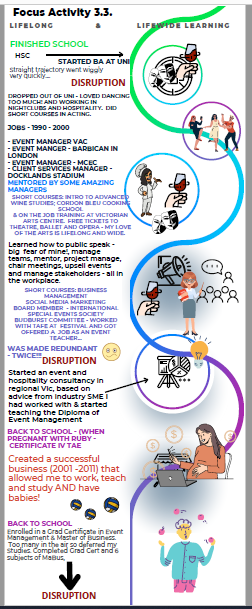

MODULE 4
John Dewey (Links to an external site.) wrote that “there’s nothing as practical as a good theory”
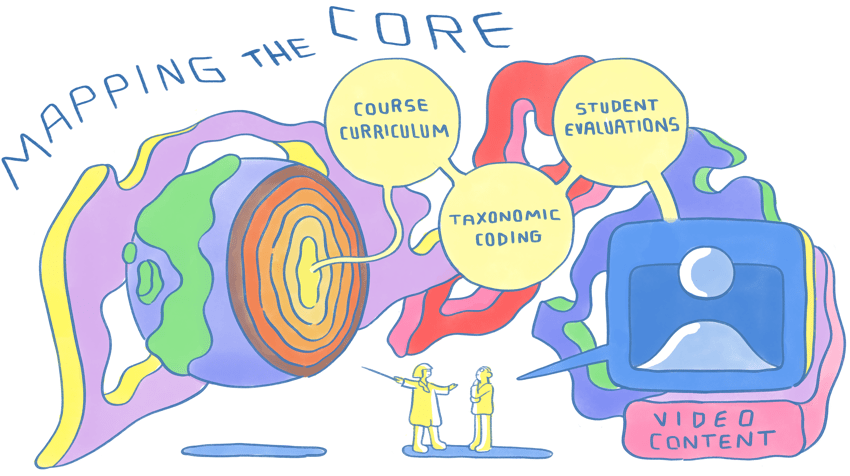
Cognitivism and Humanism – teaching theories
- Merriam, S. & Bierema, L. (2014). Traditional learning theories, Adult learning: linking theory and practice. San Francisco, CA: Josey-Bass., pp. 24-.41.
- Siemens, G. (2004). Connectivism: A learning theory for the digital age. Retrieved from https://lidtfoundations.pressbooks.com/chapter/connectivism-a-learning-theory-for-the-digital-age/
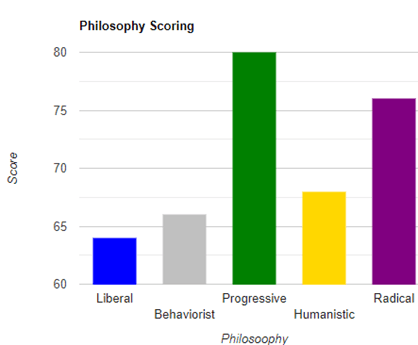
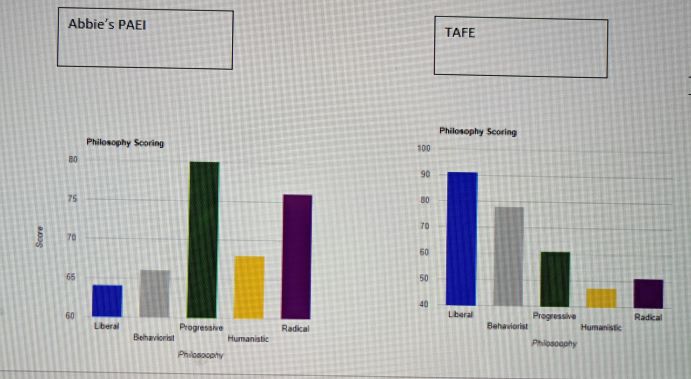
 UTS Portfolio - Professional & Organisational Learning